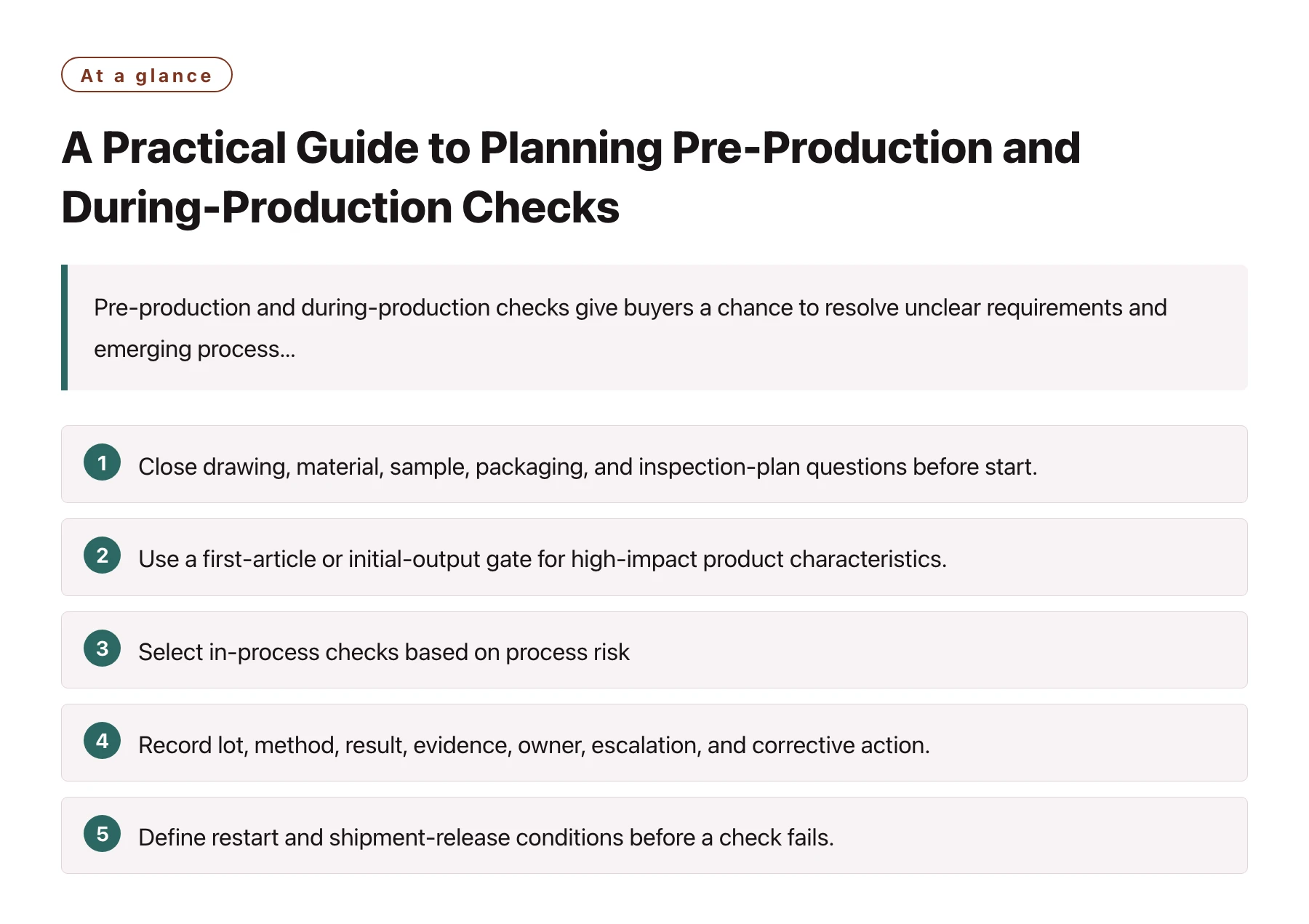
Pre-production and during-production checks give buyers a chance to resolve unclear requirements and emerging process issues before a full order is complete. Begin with a controlled specification, risk-based checkpoints, clear sample and test methods, and named decision owners. Review the first output before volume builds, then monitor selected controls during the run. These activities complement final inspection; they do not replace the supplier’s production controls or the buyer’s approval responsibilities.
Key takeaways
- Close drawing, material, sample, packaging, and inspection-plan questions before start.
- Use a first-article or initial-output gate for high-impact product characteristics.
- Select in-process checks based on process risk, change, and order complexity.
- Record lot, method, result, evidence, owner, escalation, and corrective action.
- Define restart and shipment-release conditions before a check fails.
Make each checkpoint answer a specific question and produce a decision-ready record.
1. Build the control plan from product risk
List the ordered product, intended use, factory, quantity, schedule, destination, and features most likely to affect safety, function, fit, compliance, or delivery. Trace each important feature to a drawing, material requirement, process step, test, or label. Mark unresolved requirements and assign them to the buyer’s technical owner before production begins.
A management system can provide structure for monitoring and improving processes, but product controls still need to match the order. ISO 9001:2026 specifies quality management system requirements; a factory’s certification does not itself establish that a particular first article or production lot meets the buyer’s criteria. [1]
2. Close readiness questions before production
Before the start date, confirm that supplier, factory site, approved materials, drawings, bill of materials, packaging, tooling, work instructions, test equipment, and inspection plan are aligned. Record revisions and make sure the production team has current files. Identify outsourced operations and how changes at subcontractors will be controlled.
Set a readiness review with the supplier and buyer contacts. Ask what could block the line: missing materials, unapproved samples, incomplete tests, setup issues, capacity conflicts, or unclear acceptance limits. If a critical requirement is still open, decide whether production can proceed under an authorized hold or should wait. Do not let a schedule entry become silent technical approval.
3. Define the first-output or first-article gate
Select the initial unit, component, or short run that will demonstrate the production setup. Define which features will be measured, function-tested, visually reviewed, or matched to approved samples. Identify instruments, fixtures, environmental conditions, and tolerances. Record model, process settings where relevant, material lot, date, and operators or reviewer.
Choose a decision authority for approval and state whether the line may continue while results are under review. For high-risk characteristics, wait for qualified review or laboratory evidence before releasing volume. If the first output fails, stop the affected operation, contain work since setup, investigate the cause, and document what must be repeated after correction.
4. Choose in-process checkpoints that can detect change
Focus checks on process steps where defects can be created or escape: material preparation, cutting, forming, coating, assembly, welding, filling, labeling, or other product-specific operations. Choose frequency based on risk, process stability, lot size, and change history. Explain who checks, what sample is selected, which record is completed, and what triggers escalation.
Avoid arbitrary inspection frequency that cannot be maintained or does not connect to a failure mode. For a stable routine step, operator checks and periodic verification may be appropriate; a new process, tool, material, or supplier may need closer review. The supplier should maintain its own controls even when the buyer or third party observes selected steps.
5. Keep measurement and evidence reliable
Write the measurement method, units, instrument, acceptance limit, sample identity, and result format on the checklist. Confirm that equipment is suitable and its calibration or verification status is available. For functional checks, state operating sequence and pass condition. For visual checks, define lighting and reference sample where appearance matters.
Link each result to product code, lot, process stage, date, and inspector or operator. Keep photographs legible and labeled. Record missing, inaccessible, or unperformed checks honestly. A result that says “OK” without the item, method, or limit may be difficult to use when a later lot or customer complaint needs investigation.
6. Manage findings and restart criteria
When a check fails, identify the affected period, quantity, operation, and downstream product. Contain suspect work and notify the named owner. Record the observed condition, requirement, evidence, immediate correction, and proposed cause. Do not assume that sorting all visible defects resolves a process problem or prevents recurrence.
Define corrective-action steps: investigation, action owner, due date, verification sample, effectiveness check, and whether work may resume. Set a restart gate when required. If the supplier requests a deviation, require the buyer’s authorized technical or commercial approval with scope, quantity, rationale, and conditions. Preserve the original finding and closure evidence together.
7. Coordinate checkpoints with production and delivery
Publish a schedule with readiness review, first output, in-process visits, corrective-action review, final inspection, and shipment date. Give each stage a notice period, responsible contact, required quantity, and evidence package. Confirm the line will not move past a hold point without the named release. Update the schedule when production order, supplier, material, or shipment plan changes.
Make sure inspection access is realistic. Confirm factory hours, site safety, travel, language, photography, and whether the product can be safely sampled. If the first notice is too short or goods are not ready, record the missed condition and reset the visit rather than presenting a limited observation as a complete check.
8. Use findings to improve the next run
After production, compare planned checkpoints with actual defects, escapes, rework, delays, and repeated documentation gaps. Identify which controls detected the issue and which were ineffective. Ask the supplier to review trends and propose a measurable process improvement. For repeat orders, preserve the approved control plan and revise it only through a documented change.
Buyers arranging product quality checks in China can coordinate first-article and in-process evidence with final inspection. Keep the scope product-specific, assign technical decisions to qualified owners, and ensure the final release considers all open findings and required records.
Sources
Frequently asked questions
What is the difference between first-article and during-production checks?
A first-article gate evaluates initial output after setup against approved requirements. During-production checks monitor selected process or product characteristics as the run continues.
Should production stop when a check fails?
Define the hold and restart rules in advance. Contain affected work, notify the authorized owner, investigate scope, and resume only when required correction and verification are complete.
Can a factory quality certificate replace in-process checks?
No. A management-system certificate has an organizational scope. Order-specific first output, process records, tests, and acceptance decisions may still be needed.
How should buyers choose in-process check frequency?
Base it on product and process risk, lot size, process changes, failure history, and ability to detect defects early. Record the rationale and escalation threshold.